
Friday, July 25th Legislative & Public Health Updates
- Jul 25, 2025
- 12 min read
Dear friends,
I am writing to you today with legislative, public health, and Cambridge updates. If you want even more updates, please follow me on Instagram @repdecker.
As you may know, the Trump administration has cut $1.1 billion for the Corporation for Public Broadcasting (CPB) — a move that cuts all federal support for NPR, PBS, and their member stations. Federal funding has historically ensured that our local public radio and TV stations can provide essential news, programming, and community-based services. If you are able, I encourage you to support WBUR and WGBH with a one-time or monthly donation.
Table of Contents
Legislative Updates
Public Health Updates
A Glimpse at the Past Week
Cambridge Updates
Services and Resources
Legislative Updates
Chapter 90 Funding
On Wednesday, I voted with my colleagues to pass a $1.2 billion bond bill for the Chapter 90 Program, a funding source that municipalities can use for transportation-related improvements, including road and bridge repairs. The bill includes a one-year authorization of $300 million for the Chapter 90 Program, a 50% increase over past funding levels, and funds for transportation programs that will address regional needs and the impacts of climate change on local infrastructure.
Hearings on Bills That I Filed
I am grateful to the Chairs of the Education, Labor and Workforce Development, Municipalities and Regional Government, Housing, and Public Safety and Homeland Security Committees for holding legislative hearings this week on 7 of my bills:
An Act to establish the Whole Child Grant Program (H.544), which would establish a trust fund that would disperse funds to school districts through a formula grant. Funds would be provided per pupil based on the percentage of a district’s student population designated as low income.
An Act relative to MassHealth reimbursement to schools (H.545), which would allow school districts and local educational agencies to receive and retain MassHealth reimbursements for school-based medical services and administrative activities.
An Act relating to privileged communication between individuals and their labor organizations (H.2087), which would establish a legally protected confidentiality standard between workers and their labor organizations, similar to attorney-client privilege
An Act securing the application of Massachusetts law to employees of employers incorporated or operating in Massachusetts who provide their labor and services remotely (H.2090), which would ensure that Massachusetts labor laws apply to remote employees working for companies incorporated, headquartered, or operating in Massachusetts, regardless of where the work is physically performed — unless a valid, mutually agreed contract specifies otherwise and complies with another jurisdiction’s laws.
An Act authorizing the city of Cambridge to expand the options available to issue notices of violation for parking enforcement above the limits set forth in M.G.L. C. 90, §20A½ or other applicable state laws (H.4231), which would allow the City of Cambridge to issue parking violation notices by mail if it is not possible or safe to place the notification on the vehicle. In addition, it would allow the City of Cambridge to issue violations through automated license plate readers and similar technologies.
An Act providing upstream homelessness prevention assistance to families, youth, and adults (H.1488), which would enshrine the Residential Assistance for Families in Transition (RAFT) program in statute and expand access to include those not actively involved in eviction proceedings but at risk of eviction or foreclosure.
An Act establishing a commission on municipal emergency medical service staffing levels and workforce development (H.2587), which would establish a 15-member commission to study municipal emergency medical service (EMS) staffing and workforce development, with the goal of evaluating current challenges, reviewing workforce programs, and recommending improvements to EMS efficiency, staffing standards, and training.
Public Health Updates
First case of EEE Detected in Massachusetts Mosquitoes
For the first time this year, the Massachusetts Department of Public Health (DPH) detected Eastern equine encephalitis (EEE) virus in a mosquito sample collected on July 21, in Belchertown, located in Hampshire County. Notably, 2024 was an active EEE season in the Commonwealth, with four human cases and one death. There is no treatment for EEE, and nearly half of the people diagnosed with the virus succumb to it. At this time, no human or animal cases of EEE have been detected. DPH recommends applying insect repellent containing DEET or permethrin, wearing long sleeves and long pants when doing outdoor activities, and draining any standing water around your home to prevent mosquitoes from breeding. Track local risk levels for EEE and other mosquito-borne illnesses here.
Federal Court Injunction Blocks Medicaid Payments to a Majority of Planned Parenthood Affiliates
On Monday, Planned Parenthood won a partial victory against the Trump administration in the legal battle over the administration’s efforts to defund the sexual and reproductive health care organization. The suit focused on a provision of Donald Trump’s domestic policy law barring Medicaid recipients from receiving services from a health care provider that also provides abortion care services. Judge Indira Talwani, of the Federal District Court in Massachusetts, initially issued a 14-day restraining order permitting nearly all Planned Parenthood affiliates to continue receiving Medicaid payments. Judge Talwani’s preliminary injunction now partially extends the restraining order. Planned Parenthood League of Massachusetts is not covered by the injunction; the organization will continue to provide care for Medicaid patients in the Commonwealth without billing for those services for now, as they work to develop a long-term plan. The injunction will remain in force until the outcome of the case is decided. More updates regarding Planned Parenthood of Massachusetts can be found here.
HHS Adopts Recommendation Removing Safe Preservative from Flu Vaccines
This week, the Department of Health and Human Services (HHS) adopted a recommendation from the Centers for Disease Control and Prevention’s (CDC) Advisory Committee on Immunization Practices (ACIP) to remove thimerosal, a mercury-based preservative, that anti-vaccine organizations have falsely linked to autism, from some flu vaccines. HHS Secretary Robert F. Kennedy Jr. signed this recommendation, despite the lack of clear evidence that this preservative causes human harm. However, there is robust peer-reviewed research that supports the safety of vaccines containing thimerosal. This decision will not impact most Americans seeking flu vaccines, as a majority of people receive flu vaccines from single-dose vials that already do not contain this preservative. Vaccine manufacturers have come forward stating that they can replace thimerosal-containing multidose flu vaccine vials, ensuring that flu vaccine supplies should remain uninterrupted this upcoming flu season.
Study Finds High Levels of Neutral PFAS in Reusable Menstrual Products
A recent study of reusable menstrual products found that many contain high levels of neutral per- and polyfluoroalkyl substances, commonly known as PFAS or "forever chemicals." Typically, PFAS research focuses on ionic PFAS, those that have a positive or negative charge; however, new technology has enabled researchers working on this study to measure the amount of neutral PFAS, those without any charge. High exposure to PFAS, regardless of the charge, is harmful to human health. According to environmental science experts, neutral PFAS can be more easily absorbed through the skin or mucous membranes, making it especially concerning that they have been discovered at such high levels in reusable menstrual products. This study analyzed a total of 59 reusable period products, including period underwear, reusable pads, and menstrual cups. Scientists found that extremely high levels of neutral PFAS were present in 19 products. Currently, there are no clear regulations for neutral PFAS, and further research is needed to determine their exact impact on human and environmental health.
Biopharma Company GSK to Lay Off 150 Employees in Cambridge Between October and March
This week, British biopharmaceutical company GlaxoSmithKline (GSK) revealed plans to lay off 150 employees in its Cambridge operations by the end of March 2026. The company plans to move manufacturing of vaccines that protect against pneumonia and related illnesses from Cambridge to a new location in Pennsylvania. Last month, the Healey-Driscoll administration awarded GSK $2.7 million in tax incentives through the Massachusetts Life Sciences Center (MLSC) Tax Incentive Program to create 150 jobs in the area. Earlier this year, the company also announced plans to relocate its vaccine research and development teams, as well as its infectious disease teams, from Maryland to Cambridge in 2026. GSK operates two additional sites in Cambridge – Cambridge Park Drive and Technology Square – and another site in Waltham.
A Glimpse at the Past Week

I met with Dr. Wayne Altman, Professor and Chair of Family Medicine at Tufts University School of Medicine, on Monday afternoon, to discuss An Act relative to primary care access (H.2537), a bill currently before the Joint Committee on Public Health, as well as other primary care bills filed during this session.
Massachusetts has the highest total number of physicians per capita in the U.S. However, we have a disproportionately low number of primary care physicians. There is a saying in public health that “an ounce of prevention is worth a pound of cure,” meaning that preventing people’s health issues in the first place is better for patients and costs less in the long run. Primary care is precisely how we do this. Receiving regular primary care ensures that people can identify any potential health issues early on and avoid more expensive and invasive treatments later on.
I will continue to meet with stakeholders, advocacy groups, and physicians to gain a deeper understanding of the state of the primary care crisis in Massachusetts, ensuring that we can effectively address this issue.

On Tuesday morning, I met with the Council for Responsible Nutrition to discuss legislation before the Joint Committee on Public Health, An Act protecting children from harmful diet pills and muscle-building supplements (H.2440/H.2530/S.1620). On June 11, I heard testimony on these bills; this meeting served as another opportunity to gain further insights into the impacts these bills will have on dietary supplements. As my staff and I continue to review the over 400 bills in my Committee, we will rely on stakeholders to help inform us about the ongoing issues within the industry, thereby gaining a deeper understanding of the policy implications of these bills.

It was great to see my friend and Cambridge resident, Liz Phipps-Soeiro, Director of Library Services for Boston Public Schools, at the State House for the Joint Committee on Tourism, Arts and Cultural Development’s hearing on An Act addressing challenges facing public libraries and digital resource collections (H.3595), An Act protecting against attempts to ban, remove, or restrict library access to materials (H.3598), An Act ensuring our freedom to read in the Commonwealth (H.3591), and An Act regarding free expression (H.3594) Each of the bills aims to support public libraries and protect the right to read in Massachusetts. Political pressure, censorship, and intimidation create additional barriers to accessing reading materials. We must continue to preserve the autonomy of our libraries, ensuring they can provide literature that authentically reflects diverse identities and experiences, and safeguard the constitutional rights of students and families.
I will always be grateful to Liz for her leadership, fierce advocacy, and dedication to education, as well as for providing children across the Commonwealth with library services and resources. Massachusetts leads the nation in education and is the home of the first public school and public library. We are fortunate to reside in a state and have a Legislature that continues to prioritize intellectual freedom and lifelong learning.

I have continued to meet with stakeholders and advocacy groups to learn more about the state of perimenopause and menopause care and services in Massachusetts. This week, I met with Dr. Jess Zeidman, Chief Medical Officer of the Department of Public Health (DPH), to learn more about the services available for perimenopause and menopause through DPH. As I mentioned in my previous newsletters, I am working to craft a comprehensive menopause bill that aims to address education, coverage, and treatment of care and services, and I will share more about it soon.

On Wednesday, I had another meeting related to perimenopause and menopause, this time with Andrea Giancontieri of The Whiny GYNie. Andrea is the CEO and co-founder of The Whiny GYNie, where she works to remove the stigma surrounding conversations about perimenopause and menopause, promote awareness, and help women advocate for medical care and workplace accommodations. We discussed gaps in education and care, which have led women to seek information from friends and social media, or buy medications from unregulated manufacturers. These patient-centered conversations are critical to informing my work to develop a comprehensive bill.


On Wednesday, my staff attended a briefing hosted by the House Committee on Climate Action and Sustainability, Clean Energy Caucus and the Environmental League of Massachusetts (ELM) called Building a Resilient Offshore Wind Future. The briefing featured a panel composed of representatives from ELM, the Salem Alliance for the Environment, the National Wildlife Federation, and Climate Jobs Massachusetts. The briefing offered insight into the existing capacity of offshore wind in the Commonwealth as well as ongoing efforts to expand that capacity.
I work closely with Climate Jobs Massachusetts on two bills, related to a just transition to clean energy and conducting energy audits and renovations to improve the sustainability of schools, so I was glad to hear that the panel emphasized the essential intersection between labor and clean energy, highlighting the opportunities for job creation on these clean energy projects. The panel also addressed misinformation being spread — particularly relevant due to attacks from federal leaders — stressing how important it is to have the community involved in these projects.

My staff met with constituents who came to the State House for Mass Audubon’s Protect Animals from Rodenticide Lobby Day on Thursday. This advocacy day focused on An Act Restricting the Use of Rodenticides in the Environment (H.965), which I have co-sponsored. This bill would restrict the use of anticoagulant rodenticides in Massachusetts to protect wildlife, pets, people, and the environment and I am happy to support it.
Cambridge has already made important steps in this direction. The Cambridge City Council adopted a policy order (written in partnership with some of the constituents who visited this week) requesting the City Manager to formally ban the use of these rodenticides on all City properties and by all City contractors. In addition, the Cambridge Public Health Department has launched a Rodent Fertility Study to assess how well a non-toxic rodent fertility control product, called Evolve, will work in dense communities like ours to reduce the overall rat population over time.
Cambridge Updates
Cambridge Traffic Impacts Tomorrow, July 26
There will be traffic impacts in Cambridge on July 26 due to the Run to Home Base. This race starts and ends in Boston, but Cambridge is part of the 5K course.
Street Closures:
Massachusetts Ave from Vassar Street to Memorial Drive
Time of Closures:
9:00 AM – 12:00 PM
More information can be found on their website.
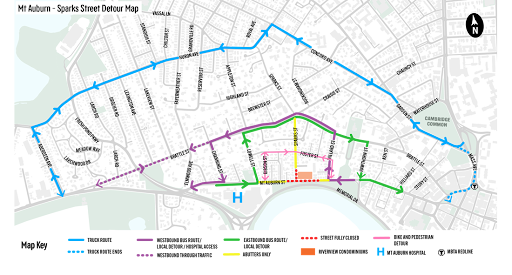
Traffic Advisory: Memorial Drive and Sparks Street Closures
Due to structural concerns at 221 Mount Auburn Street (Riverview Condominium Building), the City of Cambridge and DCR closed segments of Mount Auburn Street and Sparks Street as of Saturday, July 19. Multiple detours and traffic changes will be in place to maintain the closure, which may last through the end of 2025. The streets and sidewalks immediately surrounding 221 Mt. Auburn Street, at the corner of Mt. Auburn Street and Sparks Street, are closed to all traffic, including vehicles, bicycles, and pedestrians. Access is being maintained for direct abutters.
Services and Resources
Reproductive Care, Gender-Affirming Care, and Crisis Resources
These are a few of the resources and help lines available for people seeking reproductive or gender-affirming health care or experiencing a crisis. Help is available and you are not alone.
LUCE Defense Hotline
If you see or suspect ICE or federal agents are in your neighborhood, contact the LUCE Immigrant Defense Network’s Hotline, which operates in several languages, at 617-370-5023 from 9am-5pm. A trained operator will ask for details, then dispatch a volunteer to the site, who will attempt to verify the situation and the presence of ICE. You can learn more about LUCE and their upcoming volunteer trainings at lucemass.org.
De Novo Center for Justice and Healing
De Novo is a Cambridge-based nonprofit that provides free civil legal assistance and affordable psychological counseling to people with low incomes. Importantly, De Novo also offers high-quality, free legal assistance to low-income immigrants and asylum seekers who are living in Massachusetts. You can learn more about their immigration related services here, and their general mission and work at denovo.org.
MBTA Income-Eligible Reduced Fare Program
The MBTA’s income-eligible reduced fare program offers reduced fares to riders between the ages of 18 and 64 enrolled in an approved state assistance program, including:
Emergency Aid to the Elderly, Disabled & Children (EAEDC)
Transitional Aid to Families with Dependent Children (TAFDC)
MASSGrant
MassHealth
Supplemental Nutrition Assistance Program (SNAP)
You can learn more about the program and how to apply at mbta.com/fares/reduced/income-eligible.
Intimate Partner Abuse Prevention Helpline
This initiative is designed to prevent intimate partner violence by fostering accountability and change in people who harm or may harm their partner. You can find more information at 10to10helpline.org or by calling 877-898-3411.
SafeSpot Overdose Prevention Helpline
SafeSpot is a virtual spotting/overdose detection service for people who use drugs. Learn more at safe-spot.me or access it by calling 800-972-0590.
Alzheimer's Association Helpline
The Alzheimer’s Association is a nonprofit that provides support, research, and care for Alzheimer’s and dementia. It is available 24/7 for caregivers and patients. More information is available at alz.org, or by calling 800-272-3900.
MassLegalHelp.org is a resource to help Massachusetts residents learn about their legal rights. The website does not offer legal advice or answer individual questions but has a page about options for finding a lawyer. It does provide resources for those facing legal issues, such as a landlord refusing to make repairs, appealing the denial of SNAP benefits, and questions about getting a CORI sealed.
As always, please contact me with questions or concerns at Marjorie.Decker@mahouse.gov.
Sincerely,
Marjorie

